life, the universe and everything
Eat Issue 7: Packaging
This article was originally published in October 2001.
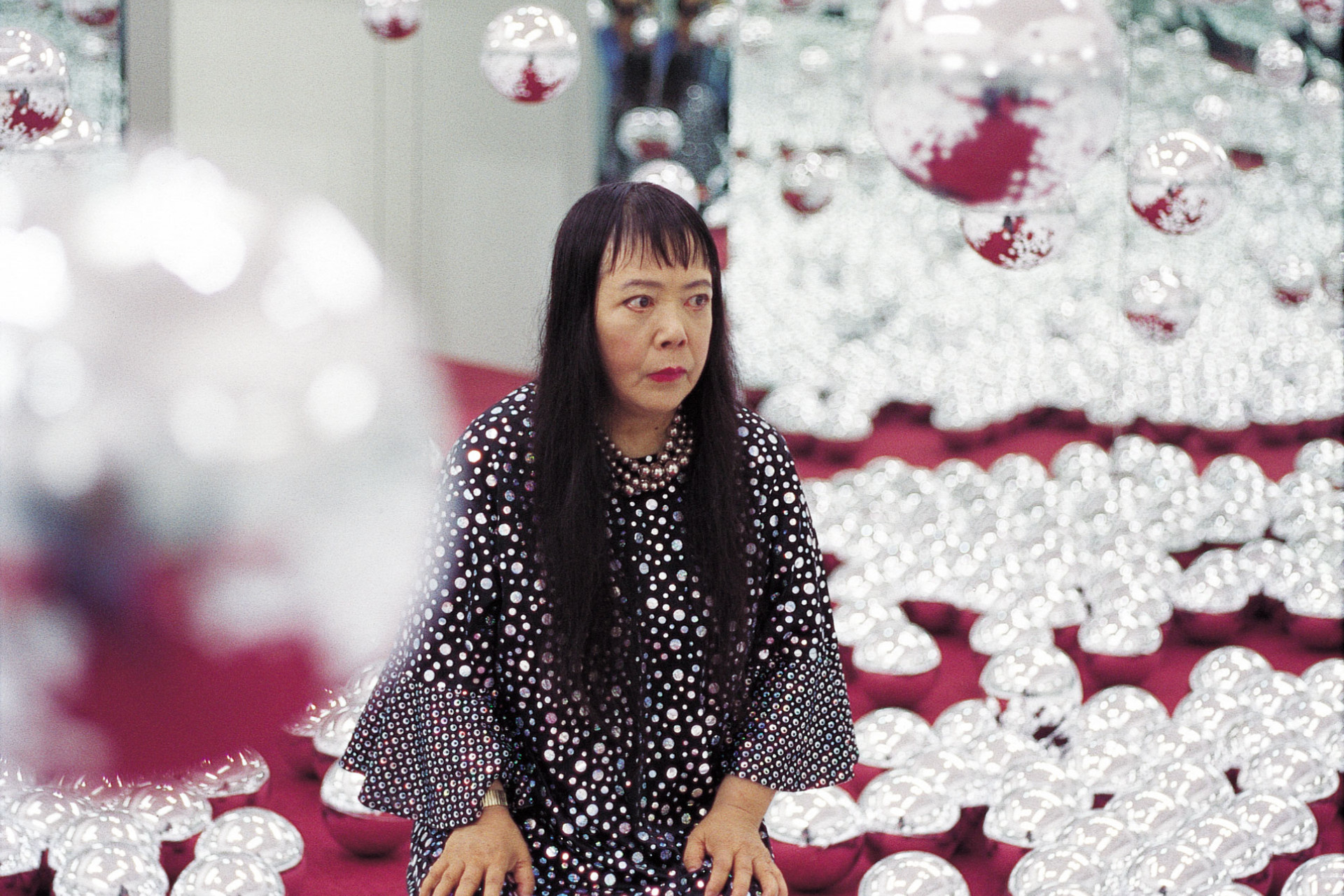
Yayoi Kusama was one of the first Japanese artists to join the 1950s New York avant garde, and the first to exhibit at the Venice Biennale, in 1966. She now lives in a Tokyo psychiatric hospital, a short walk from the studio where she revealed her thoughts on obsession, the line between her real and conjured worlds, and the gloom of macaroni.
An obvious question, when you stand in front of a Yayoi Kusama, is: How does the world look to this artist? The answer maybe simply: However she wants it to look. Kusama’s work is intense, disturbing and original. Her infinitely expanding, web-like patterns, rampant polka dots and penis-like protrusions, while threatening to enmesh the universe, help us make sense of the artist’s cryptic utterances, such as: “Life, for me, is environment… And obsession.”
“My work and my self are one,” Kusama says. Her already-big eyes widen as she declares a deep love for her creations. Her presence is so strong that it makes you flinch. Ask a trivial question and she bites back: “Are you asking me that because it’s part of your job?” Yet the way that she speaks — touching her hair, her smile when the talk becomes lively — is disarmingly innocent. Probably, Kusama’s artistic ability stems from two extreme qualities: a shaman-like intensity and the purity of a child.
“I constantly think about my work, whether I’m walking, eating or asleep,” she says. “When something interesting comes along, I wake up and start sketching.” Her ability to concentrate seems to have been gifted her, along with the prevailing mental ailments of neurosis and obsession.
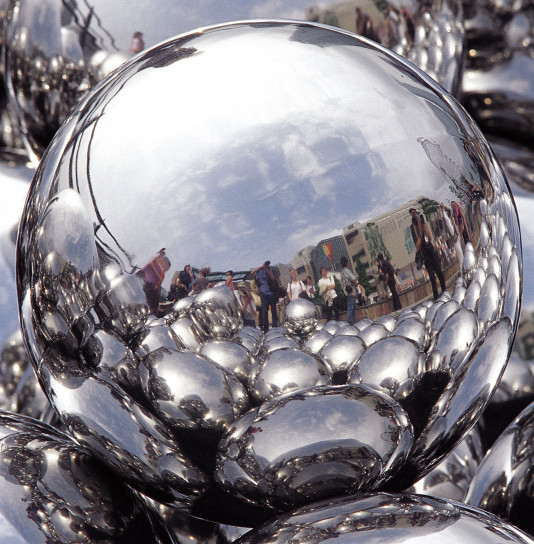
Kusama was born to a relatively rich family in Nagano prefecture, and as a child saw illusions and heard animals and plants speak. “And ever since I was small, I always drew. Even through mealtimes.” Growing up she worked intensively. At age 14 she resolved to become a painter. It took seven years to persuade her parents to help her go to New York. She arrived in 1957 — a peak of the city’s artistic activity, and through her debut shortly afterwards, showing works of white dots, slipped into the avant garde. From two-dimensional works she expanded to other genres: sculpture, installation, public-art “happenings”, design work in fashion, the publication of her weekly magazine Kusama Orgy, and more.
Many artists helped her — in the beginning Georgia O’Keefe, then the colourist Donald Judd, and Warhol, among others. There were days when she collapsed from overwork. “When I keep drawing non-stop, I see my pictures everywhere around me and that makes me lose the line between my paintings and reality. It means I never had a moment’s peace.” Despite arriving in New York with one million yen from her parents (enough to build two houses in Japan at the time), Kusama found the going tough. To avoid the trouble of renting a vehicle, the slightly built artist carried her paintings on her back to museums and galleries. “One of those paintings was about 33 feet long, since I keep drawing small patterns over and over,” she says.
“I am like an ascetic.” Perhaps — if by ascetic you mean one who grapples with their fears by covering mannequins or the floor with macaroni, or making chairs and boats bristling with penis-like objects. “Macaroni is an industrial product unlike bread or rice,” says Kusama. “The fact that some people have to keep eating such things for life fills me with a sense of panic and doom.”
“Marriage is a hassle. It takes a lot of money to even fall in love.”
Given the penises and macaroni, it seems reasonable to ask: How does she feel about sex and food? “They area like in the sense that they are there to be consumed by humans. The way people perceive sex and food, in my opinion, is equivalent to their grasp of the meaning of life.” If this is the case, Kusama sees life as follows: “Eating is not something I enjoy. I have many other things to do. I only want to get it out of the way fast.” Of course, she is aware of the need to eat properly, “so that I can keep on painting. But there is a nutritionist at the hospital where I stay, so it isn’t an issue.” At the same time, food television and food magazines strike her as bizarre. “I wonder why they don’t focus on other things. I guess we are in an age of indulgent eating.”
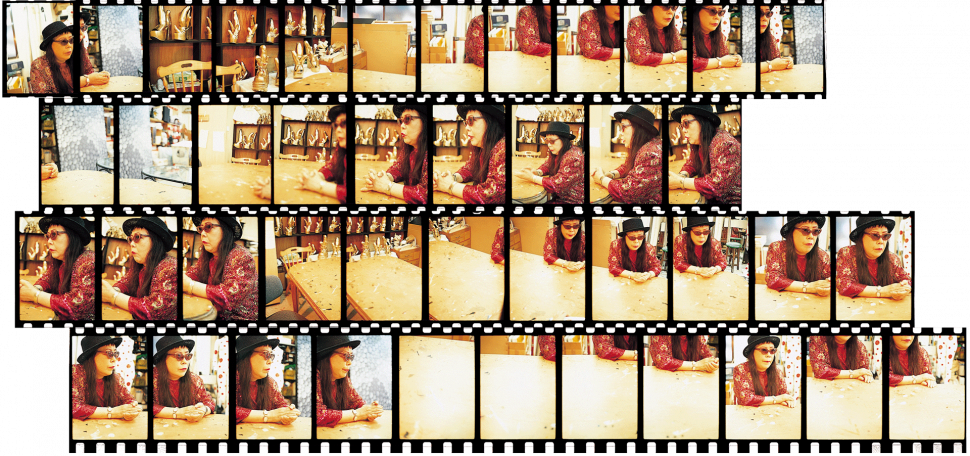
Kusama is not interested in other artists and does not socialize. One of her greatest pleasures is for her finished works to be shown, and for people to come to see them. “I think my younger fans have multiplied,” she says. “Both in Japan and overseas.” Indeed, there were many young people at her opening at Ota Fine Arts museum in Tokyo this past July. Young artists also send photographs of their work for appraisal, though according to Kusama’s staff, “Most of them have clearly been influenced by her paintings.” Such flattery would fail to impress Kusama, for whom a work without originality is meaningless. “Wouldn’t it be beautiful if we could see an ocean of fire?” she said, when invited to exhibit at the Yokohama Triennale, running now until early November.
Kusama’s staff seem to enjoy her absolute trust. Her most enjoyable times are spent with her secretary, discussing future directions and activities. “There are so many things I want to do. I also want to write a novel but I don’t have the time. Although I know I don’t need to do everything alone. I even drafted my will with my secretary!”
Finally, it seems Kusama is getting her due. This year and next there will be a retrospective at the Miami Art Museum, and her latest installations will travel seven countries around Europe. “I once struggled to choose between writing and painting, but I’m glad that I chose art,” she says. “I can send messages to people of different nationalities.” Asked if she would like to have her time over as a painter, she replies after pausing, “I would not choose to be reincarnated. I had such a hard time in this life.”
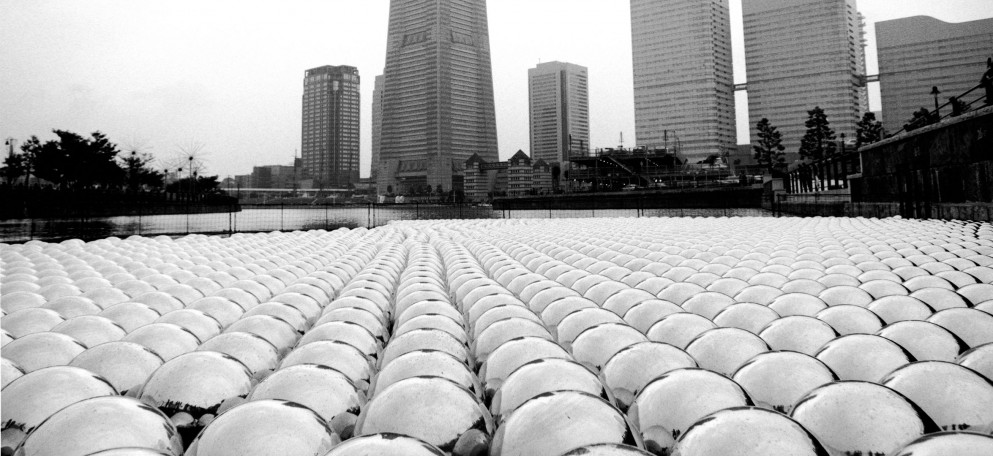
Narcissus Garden, International Triennale of Contemporary Art Yokohama 2001.
Kusama has always gone her own way and remains singularly uninfluenced by others. Her life is solitary to an extent that must be unimaginable to most people. “I get lonely,” she admits. “But marriage is a hassle. It takes a lot of money to even fall in love.”On returning from her studio to the room at the hospital, she recounts the day’s events to a rabbit rag-doll that she loves like a little sister, even taking it on overseas trips. Like painting, the sojourn with the rabbit is one of the artist’s daily tasks.
Text: Kyoko Tsukada / Photo: Toshiya Abe
_page_1.jpg)
_page_2.jpg)
_page_3.jpg)
_page_4.jpg)