Chiemi Suyama
Our Eat team is diverse in background, perspectives, and expertise. In Meet Eat, we introduce the individuals behind our creative team, exploring the projects they're working on, what's inspiring them lately, and how they approach their craft.
In this edition, we spoke with Senior Designer Chiemi Suyama, touching on topics from her experiences working in the US to appreciation for print design.
Chiemi Suyama, Senior Designer
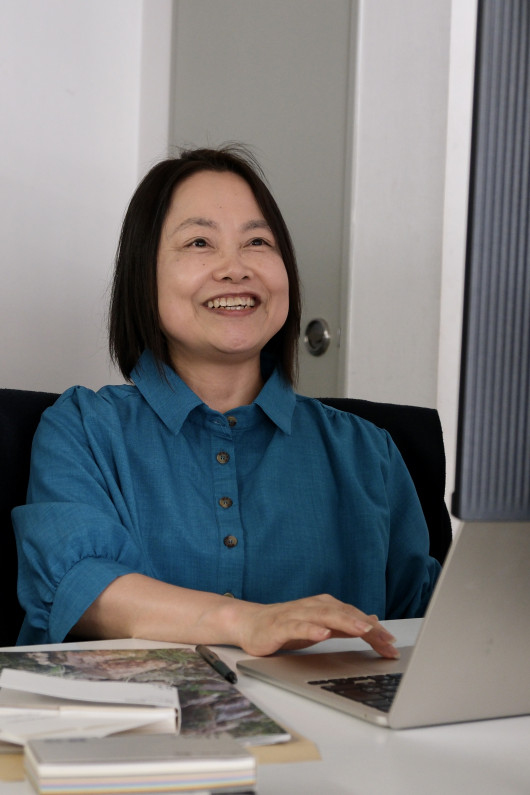
Chiemi is a senior designer and art director with many years designing, directing and leading creative projects in Japan and the US. Fluent in Japanese and English, Chiemi specialises in print and packaging design, leading cross-discipline projects and managing complex workflows whilst delivering exceptional standards of design and quality.
She supports clients across a wide range of industries, from hospitality to food & beverage, to travel and professional services. These include global hotel brand The Peninsula, Yasui Architects & Engineers, and New Zealand winery Folium Wines.
What inspired you to become a designer?
There wasn't one defining moment. I've always loved drawing and making things ever since I was a child, so becoming a designer felt like a natural path. I became fascinated with book cover design around junior high school and later became interested in editorial design.
One of the reasons I joined Eat was because of its magazine. It brought together two things I love: food and design. I began my career designing magazines and books, and during my time in the United States, my work expanded to focused on brand localisation and packaging design.
What did you learn and experience, working as a designer in the US?
One thing I quickly realised while working on packaging design was just how much responsibility rested on each designer.
At the time, in Japan, final print files were carefully checked and adjusted by prepress specialists and printers before production. In the US, however, CTP (Computer-to-Plate) printing had already become the standard. Designers were often responsible for the final production files themselves, meaning that if any issues were discovered, we had to correct the files and resubmit them.
Packaging labels are often printed in runs of more than 100,000 units, so the stakes were incredibly high. I remember feeling nervous every time we sent artwork to print. Perhaps because of that level of responsibility, many larger agencies had a hive-like workflow, where a dedicated production team would take the designer's artwork and prepare it as print-ready files.
What type of packaging did you design in the US?
Much of my work involved localising packaging for Japanese food and beverage brands such as Ozeki, Sapporo, Pokka, and Kikkoman. I also worked on catalogues and packaging for food distributors importing Japanese and other Asian food products.
Even something as simple as a can has many different production requirements. A paper label applied to a can requires different specifications from artwork printed directly onto the can itself. Frozen foods also have different regulations and labelling requirements from dry goods.
Every product category came with its own technical knowledge and industry standards, so every project was a new learning experience.
What kind of adaptations were needed when localising Japanese products for the US market?
Products often needed to be adapted to meet different regulations and consumer expectations, which sometimes meant changing not only the packaging but also the product itself.
At the time, for example, sake sold in the United States needed to be junmai (with no additive alcohol), so although it carried the same Ozeki name, its flavour differed significantly from the product sold in Japan. Yebisu Beer also couldn't be labelled as ‘beer’ in California, because its alcohol content exceeded 5%, meaning it had to be marketed differently.
Some brands even developed products exclusively for overseas markets. Sapporo, for example, introduced a premium beer specifically for international markets, which I’m happy to see is still available today!
What do you find appealing about print design in today's digital age?
What makes print so special is that it engages all five senses.
The same design can feel completely different depending on whether it's printed on coated stock or textured cotton paper. The tactile quality, the scent of the paper, and even the way colours appear under natural versus artificial light all contribute to the experience. There's something deeply satisfying about these physical qualities, much like appreciating a work of art.
Precisely because we live in such a digital world, I think we need to make space for these quieter, more tactile experiences.
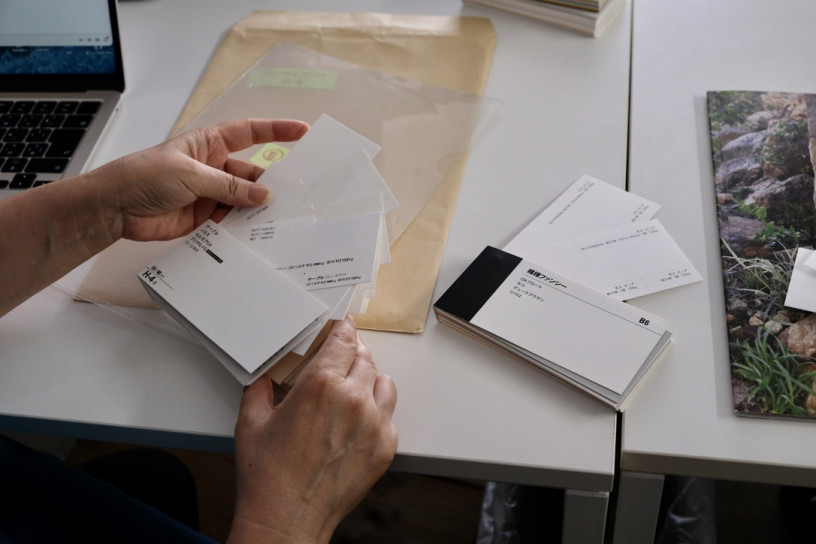
Chiemi compares different paper samples, considering texture, color and feel.
What design or creative topics have you been thinking about recently?
It's probably the obvious answer, but AI and how to build a healthy relationship with it.
Just like human relationships, I think it's all about finding the right balance. AI tends to be very enthusiastic and persuasive, and it's surprisingly good at flattering you. Because of that, I try to engage with it thoughtfully rather than relying on it too heavily.
What is most important to you as a designer?
Design trends evolve so quickly now, and fascinating things are happening all over the world that we may never even hear about. Whether I choose to follow those trends or not, I always want to stay curious and keep my antenna up.
Do you have any habits or routines that are essential to your work?
I make a conscious effort to spend time away from work, whether that's doing yoga, reading, or watching films.
Design is one of those professions where ideas can come to you anywhere, at any time, so it can easily become a 24-hour job. Having clear moments to switch off is incredibly important.
What do you think makes Eat unique?
I think it's our relentless curiosity and our genuine desire to create things we truly believe in.
Sometimes we spend more time or money than we probably should pursuing something that excites us, and occasionally we regret it afterwards. But I think approaching our work with that level of passion is something worth holding onto.
Is there anything you'd like to challenge yourself with next?
Our core team at Eat is relatively small, but now that we've become part of the Capel Group, I expect we'll have many more opportunities to collaborate with design teams around the world.
I'm excited to learn from those differences, whether it's different cultures, different ways of using AI, or different approaches to running projects. We can help each other grow and gain new experience through these collaborations.
Interested in joining our team? If so, we’d love to hear from you. Please send in your CV to work@eatcreative.jp and let us know how you think you can help us grow.